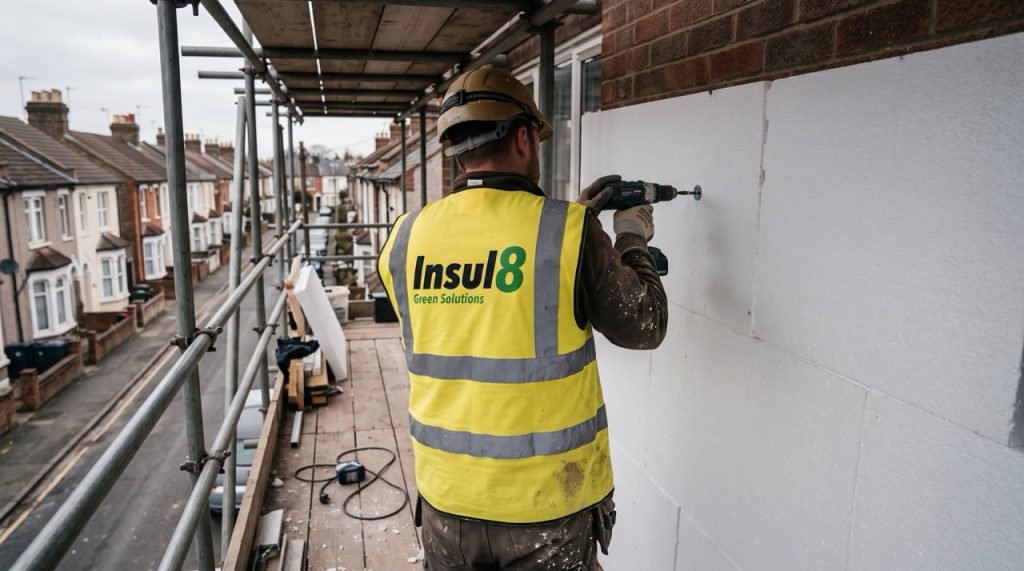
External wall insulation is one of the most effective ways to improve the energy efficiency of a home — but it’s not right for every property. Whether it’s suitable for yours depends on the type of walls you have, the condition they’re in, and a few other factors that a proper survey will confirm.
This guide covers everything you need to know: who EWI is designed for, what makes a property suitable or unsuitable, what the installation involves, and how to find out whether it’s the right solution for your home.
Jump straight to our EWI service page
What Is External Wall Insulation?
External wall insulation (EWI) involves fixing a layer of insulation material to the outside of your home’s walls, then covering it with a protective render or finish. Unlike cavity wall insulation — which fills a gap that already exists between two layers of brick — EWI adds insulation to the outside of the structure itself.
This makes it the go-to solution for properties that don’t have a usable cavity: particularly solid-wall homes built before the 1920s, which account for around a third of UK housing stock and are among the hardest to heat efficiently.
It also has a significant visual benefit — a fresh render finish can transform the appearance of a property at the same time as improving its thermal performance.
Who Is EWI Designed For?
EWI was originally developed as a solution for solid-wall properties — the Victorian and Edwardian terraces, semi-detached homes and older detached properties that make up a large part of the UK’s older housing stock. These homes were built without cavities, so there’s no gap to fill with traditional insulation materials.
However, EWI is also used on cavity-wall properties where the cavity isn’t suitable for filling — for example, where walls are in poor condition, the cavity is too narrow, or the property is in a highly exposed location where cavity insulation could cause moisture problems.
It’s also increasingly popular for homeowners who are planning to re-render or refurbish the exterior of their property anyway — combining the two projects into one makes obvious sense.
How Do I Know If My Home Has Solid Walls?
The quickest way to check is to look at the brickwork pattern on an external wall:
- Alternating long and short bricks (“headers” and “stretchers”) — almost certainly solid walls
- All bricks the same length (“stretcher bond”) — almost certainly cavity walls
You can also check wall thickness. Measure the depth of a window or door reveal — solid walls are typically 230mm or more, while cavity walls are usually around 300mm. If you’re not sure, a borescope inspection during a survey will confirm it quickly.
As a rule of thumb: if your home was built before 1920, it almost certainly has solid walls. Homes built between 1920 and 1935 are a mixed picture — some have cavities, some don’t. Post-1935 homes are generally cavity construction.
What Makes a Property Suitable for EWI?
EWI is suitable for a wide range of properties. The key factors that determine suitability are:
Wall type
Solid walls are the primary candidate. EWI can also work on cavity-wall properties where the cavity isn’t suitable for filling — your installer will confirm which applies.
Wall condition
The existing wall surface needs to be structurally sound. Damaged render, loose brickwork or significant cracks need to be addressed first — not because they rule out EWI, but because they need to be right before the system is applied.
Existing damp
Any active damp needs to be identified and resolved before EWI is installed. Insulating over a damp problem locks the moisture in rather than fixing it. A good installer will check for this during the survey and advise accordingly.
Planning considerations
Most EWI installations are covered by permitted development rights — meaning you don’t need planning permission. However, listed buildings, properties in conservation areas and some leasehold properties may require permission or approval. Your installer will flag anything that applies during the survey.
Pipework and fixtures
EWI adds thickness to your walls — typically 60–150mm depending on the system and specification. This means external pipework, meters, airbricks, windowsills and door surrounds all need to be considered. A competent installer will plan for and manage all of this as part of the project.
What Might Rule Out EWI?
EWI is suitable for most properties, but there are situations where it’s not the right answer:
- Listed building status — changing the external appearance of a listed building usually requires listed building consent
- Conservation area restrictions — some areas have specific rules about changes to external appearances; your installer will check
- Very narrow plots or tight boundaries — where the added wall thickness would encroach on boundaries or significantly affect neighbouring properties
- Severe unresolved structural issues — EWI is not a remedy for structural problems; these need addressing first
If any of the above apply, it doesn’t necessarily mean EWI is off the table — it means a proper assessment is needed before any decisions are made.
Can EWI Be Used Alongside Other Insulation?
Yes — and in most cases it should be. EWI addresses heat loss through the walls, but up to 25% of a home’s heat can also escape through the roof. Combining EWI with loft insulation (or roof insulation for converted lofts) gives you a significantly more efficient home overall.
If your home has solid walls and no loft insulation, a whole-home assessment is the most effective starting point — we can identify where the biggest heat losses are and help you prioritise accordingly.
See our loft insulation service
What Are the Benefits of EWI?
- Significant reduction in energy bills — solid-wall homes lose far more heat than cavity-wall properties; EWI addresses this directly
- Warmer, more comfortable rooms — particularly in older homes that have always been difficult to heat
- Transformed exterior appearance — a new render finish gives your property a clean, refreshed look
- Improved EPC rating — important for property value, mortgage eligibility and landlord compliance
- Reduced condensation — warmer internal wall surfaces mean less moisture build-up inside
- Long-lasting with minimal maintenance — a quality EWI system is designed to last decades
Can I Get a Grant for External Wall Insulation?
Potentially, yes. External wall insulation is one of the measures supported under the ECO4 scheme (Energy Company Obligation) and the Great British Insulation Scheme (GBIS), both of which are designed to help lower-income and vulnerable households improve their home’s energy efficiency.
Eligibility is based on a combination of household income, existing EPC rating and property type. Solid-wall properties with a low EPC rating are often strong candidates for grant funding, particularly where the household receives certain benefits.
We check eligibility and manage all the paperwork as part of every project — so if there’s funding available for your home, we’ll find it.
How Do I Find Out If My Home Is Suitable?
The only reliable way to know for certain is a proper survey. EWI suitability depends on a combination of factors — wall type, condition, exposure, access, planning status and existing damp — that can’t be assessed from a postcode or a photo.
At Insul8, every project starts with a free, no-obligation survey. We assess your property in person, confirm suitability, discuss your options and give you a fixed quote — before any commitment is made.
If EWI isn’t right for your home, we’ll tell you — and if there’s a better solution, we’ll recommend it.
INSUL8 installed external wall insulation on our house. We found them to be very professional and reliable, keeping us informed throughout the project. Our property has been totally transformed and our energy costs will be significantly reduced. I wouldn’t hesitate in recommending INSUL8.
Summary: Is EWI Right for Your Home?
- EWI is the go-to solution for solid-wall properties built before the 1920s
- It can also work on cavity-wall properties where the cavity isn’t suitable for filling
- Wall condition, damp and planning status all need checking before installation
- Grant funding may be available under ECO4 or GBIS — we check eligibility as standard
- A free survey is the only reliable way to confirm suitability for your specific property
Find Out If Your Home Qualifies
Book a free, no-obligation survey with Insul8 and we’ll tell you exactly whether external wall insulation is the right solution for your property — and what it could mean for your energy bills.